
The Inheritance of Thunder (1029–1064)
Introduction: The Shadow of the Great Seljuks
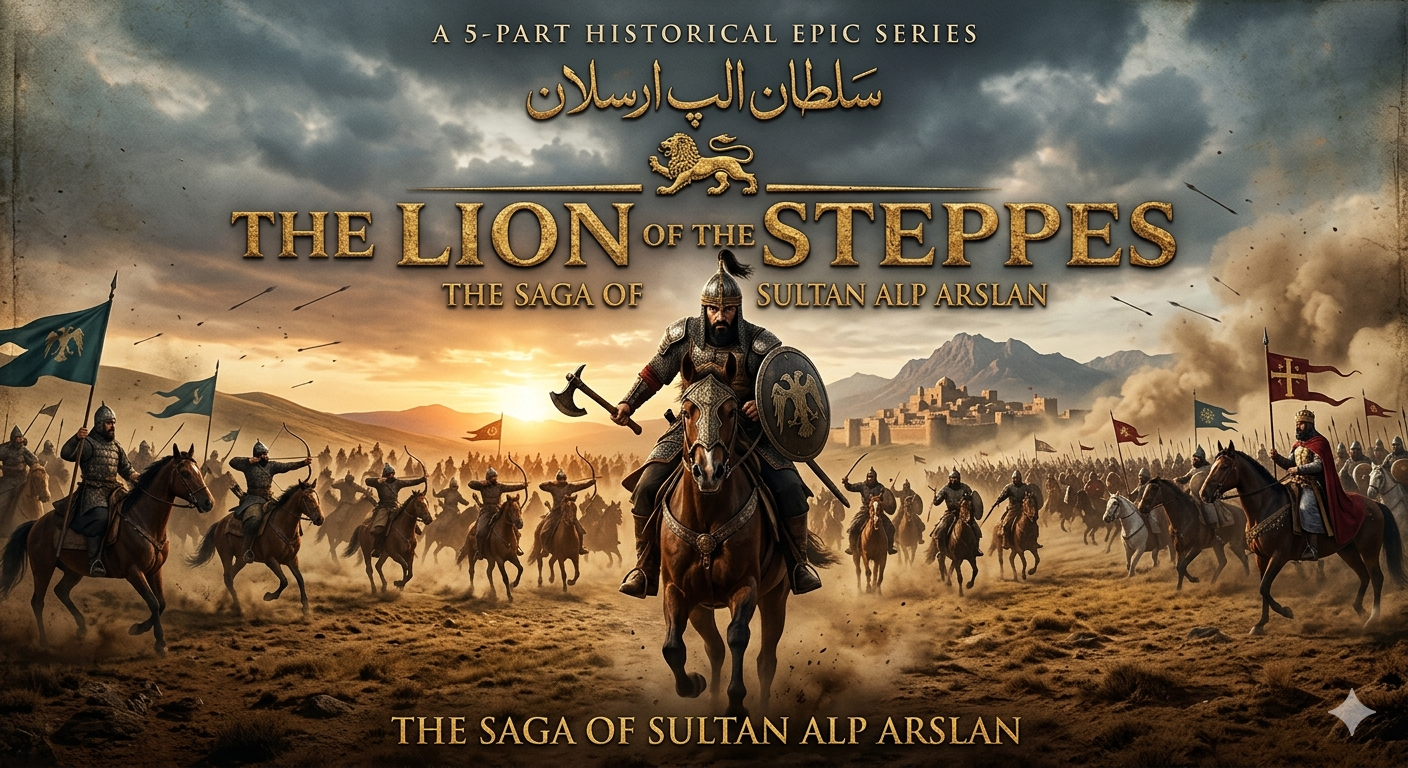
In the vast, wind-swept expanses of Central Asia, a new power was carved out of iron and horsehair during the 11th century. The Seljuk Empire, a Turko-Persian Sunni Muslim empire, had risen from nomadic roots to become the protectors of the Abbasid Caliphate. At the heart of this storm stood a man whose name would become synonymous with bravery: Alp Arslan (the “Heroic Lion”).The Lion of the Steppes: The Saga of Sultan Alp Arslan
Born as Muhammad bin Dawud Chaghri in the late 1020s, he did not just inherit a throne; he inherited a mission to solidify the fragmented Islamic world and push the frontiers of the Oghuz Turks toward the setting sun.
I. Roots of the Lion: The House of Seljuk
To understand Alp Arslan, one must understand the house from which he sprang. The Seljuks were part of the Kinik tribe of the Oghuz Turks. His uncle, Tughril Bey, and his father, Chaghri Bey, were the dual architects of the empire. While Tughril handled the political diplomacy in Baghdad, Chaghri—Alp Arslan’s father—was the military genius who secured Khorasan. The Lion of the Steppes: The Saga of Sultan Alp Arslan
Growing up in the saddle, Alp Arslan was raised in a world where the sword was the only law. He witnessed the Battle of Dandanaqan (1040), where his family decisively defeated the Ghaznavids, effectively ending their dominance in Iran and marking the true birth of the Seljuk State. This environment forged a leader who was not only a master tactician but also deeply pious, viewing his conquests as a means to spread and protect the faith.
II. The Young Governor
Long before he was Sultan, Alp Arslan proved his mettle as the Governor of Khorasan. Following his father Chaghri’s death in 1059, the young prince took over the administration of this vital eastern province. It was a baptism by fire. Khorasan was a land of rebellious local lords and constant pressure from the pagan tribes of the north. The Lion of the Steppes: The Saga of Sultan Alp Arslan
During this period, he developed the “Seljuk System” of governance:
- Mobile Warfare: Utilizing the unrivaled speed of the Turkish horse archers.
- Persian Administration: Utilizing the intellectual depth of Persian viziers to manage the bureaucracy of a growing empire.
- Religious Legitimacy: Aligning strictly with Sunni Islam to gain the favor of the Caliph in Baghdad.
III. The Crisis of Succession
In 1063, the Great Sultan Tughril Bey passed away without an heir. The empire teetered on the edge of civil war. Tughril had initially designated Alp Arslan’s infant brother, Suleiman, as his successor—a move supported by the vizier al-Kunduiri. The Lion of the Steppes: The Saga of Sultan Alp Arslan
However, Alp Arslan and his cousin Kutalmesh (the father of the future founder of the Sultanate of Rum) both laid claim to the throne. Kutalmesh was a formidable warrior who believed that as the eldest of the family, the throne was his by right of blood.
The struggle was brief but bloody. Alp Arslan marched from Khorasan with a veteran army. In the ensuing battles, his superior leadership and the loyalty of his troops turned the tide. Kutalmesh perished in the conflict, and Alp Arslan entered the city of Rayy (near modern-day Tehran) to be crowned the second Sultan of the Great Seljuk Empire on April 27, 1064. The Lion of the Steppes: The Saga of Sultan Alp Arslan
IV. The Arrival of Nizam al-Mulk
One cannot tell the story of Alp Arslan without mentioning the man who stood at his right hand: Nizam al-Mulk. Originally a secretary for Chaghri Bey, Nizam al-Mulk became Alp Arslan’s Grand Vizier.
This partnership was one of the most successful in history. While Alp Arslan focused on the battlefield, Nizam al-Mulk focused on the “Nizamiyyah” madrasas, the legal system, and the “Siyasatnama” (The Book of Government). Together, they transformed a nomadic war machine into a sophisticated Islamic civilization.
V. First Steps Toward Greatness: The Conquest of Ani
With his internal rivals silenced, Alp Arslan turned his gaze westward. He did not seek mere plunder; he sought to secure the borders of Islam against the Byzantine Empire and the Fatimid Caliphate. The Lion of the Steppes: The Saga of Sultan Alp Arslan
In 1064, he launched a campaign into Armenia and Georgia. The centerpiece of this campaign was the siege of Ani, a city so well-fortified it was considered “impregnable.” Using massive siege engines and a relentless assault, Alp Arslan breached the walls. The fall of Ani sent shockwaves through Christendom and the Islamic world alike. The Caliph Al-Qa’im bestowed upon him the title “Abu’l-Fath” (The Father of Victory).
VI. The Vision for the Future
By the end of 1064, Alp Arslan had unified the Seljuk lands from the Oxus River to the borders of Byzantium. He was no longer just a tribal chieftain; he was the Sultan al-Azam (The Great Sultan).
However, his greatest challenges lay ahead. To the west, the Byzantine Emperor Romanos IV Diogenes was gathering a massive host to reclaim the East. To the south, the Fatimids in Egypt contested the religious leadership of the Ummah. The Lion was ready, his claws were sharpened, and the stage was set for the clash that would change the course of human history. The Lion of the Steppes: The Saga of Sultan Alp Arslan
The Architect of Empire (1064–1070)
I. The Consolidation of Power
After the triumphant conquest of Ani and his official recognition as the Supreme Sultan, Alp Arslan faced the monumental task of turning a collection of conquered territories into a unified state. The Seljuk Empire was vast, stretching from the borders of China to the Mediterranean, but it was also fragile. Local governors, nomadic chieftains, and sectarian rivals were constant threats to the central authority. The Lion of the Steppes: The Saga of Sultan Alp Arslan
Alp Arslan’s strategy was twofold: military deterrence and administrative excellence. He spent the years following his accession patrolling his borders, personally leading his elite “Ghulam” (professional standing army) to suppress any hint of rebellion. By doing so, he transitioned the Seljuk military from a purely nomadic militia into a disciplined, professional force that could maintain order across vast distances.
II. The Genius of Nizam al-Mulk: The Pen and the Sword
If Alp Arslan was the sword of the empire, his Grand Vizier, Nizam al-Mulk, was its brain. During this middle period of the Sultan’s reign, the duo established a governance model that would influence Islamic states for centuries. The Lion of the Steppes: The Saga of Sultan Alp Arslan
Nizam al-Mulk implemented the Iqta system, a method of land grants to military officers in exchange for service. This solved the problem of paying a large army and ensured that the land remained productive. Furthermore, he established the Nizamiyyah Madrasas—the world’s first major university system—in cities like Baghdad, Nishapur, and Isfahan. These institutions were not just religious schools; they were training grounds for bureaucrats and scholars, designed to counter the ideological influence of the Fatimids. The Lion of the Steppes: The Saga of Sultan Alp Arslan
Alp Arslan gave Nizam al-Mulk full autonomy, creating a rare historical example of a warrior-king and a philosopher-vizier working in perfect harmony.
III. The Strategic Shift: Eyeing the West
While many of his predecessors were content with raiding, Alp Arslan had a grander vision. He realized that for the Seljuk Empire to survive, it needed to secure its western flank. This meant dealing with two major powers:
- The Fatimid Caliphate (Egypt): Who challenged the religious authority of the Abbasids.
- The Byzantine Empire (Anatolia): Who held the keys to the Mediterranean and the gateway to Europe.
In 1067, Alp Arslan launched a series of daring raids into the heart of Byzantine Anatolia. His generals, like the legendary Afshin Bey, penetrated deep into the provinces of Pontus and Cappadocia. These were not mere raids for gold; they were strategic “feelers” designed to test the strength of the Byzantine defenses and to clear the way for permanent Turkish settlement. The Lion of the Steppes: The Saga of Sultan Alp Arslan
IV. The Fall of Iconium and the Byzantine Response
The capture of Iconium (modern-day Konya) by Seljuk forces sent a wave of panic through Constantinople. The Byzantines, who had long viewed the Turks as “barbarians” from the east, suddenly realized that their very existence was under threat.
The Byzantine Emperor, Constantine X Doukas, had neglected the army to save money, leaving the frontiers defended by poorly paid mercenaries. When Alp Arslan’s forces began raiding as far as Caesarea, the Byzantine aristocracy knew they needed a soldier on the throne. This desperation led to the rise of Romanos IV Diogenes, a battle-hardened general who took the crown in 1068 with one primary goal: to drive the “infidel Turks” out of Anatolia forever. The Lion of the Steppes: The Saga of Sultan Alp Arslan
V. The Diplomatic Chessboard
Despite the looming war with the Byzantines, Alp Arslan remained a diplomat. He sent several embassies to Constantinople, attempting to negotiate a peace treaty that would allow the Turks to settle on the frontiers without full-scale war. His true target at this time was actually Egypt; he wanted to unify the Muslim world under the Sunni banner.
However, Romanos IV mistook Alp Arslan’s desire for peace as a sign of weakness. The Emperor began assembling the largest Christian army the world had seen in centuries—a massive force of Greeks, Normans, Franks, Armenians, and Vikings (the Varangian Guard). The stage was being set for a collision that would reshape the map of the world. The Lion of the Steppes: The Saga of Sultan Alp Arslan
VI. The Lion’s Temperance
Historians of the time, such as Ibn al-Athir, describe Alp Arslan during these years as a man of immense self-control and piety. Despite his absolute power, he was known for his justice. He famously said that a Sultan is not one who rules over bodies, but one who wins the hearts of the people.
He spent his nights in prayer and his days in the saddle. He was preparing his people not just for a battle of soldiers, but for a battle of civilizations. By 1070, the “Heroic Lion” had stabilized his borders, enriched his cities, and was now standing on the precipice of his greatest trial.
The Gathering Storm (1070–1071)I. The Turning Point: Egypt or Anatolia?By the year 1070, Sultan Alp Arslan found himself at a strategic crossroads. His primary ideological and political ambition was not actually the destruction of the Byzantine Empire, but the unification of the Islamic world. His heart was set on Cairo. He aimed to dismantle the Fatimid Caliphate and bring the entire Ummah under the spiritual guidance of the Abbasid Caliph in Baghdad.While the Sultan was campaigning in the south, laying siege to Edessa and moving toward Aleppo, he received intelligence that changed everything. The Byzantine Emperor, Romanos IV Diogenes, had finally finished assembling his “Grand Army of the Cross.” It was a force of unprecedented scale, estimated between 40,000 to 70,000 soldiers,
including elite Frankish knights, Norman mercenaries, and the fierce Varangian Guard.Romanos’s message was clear: he was not coming for a border skirmish; he was coming to wipe the Seljuks off the map and reclaim the lost lands of the East.II. The Sultan’s Strategic RetreatAlp Arslan was in a precarious position. Most of his veteran cavalry was far to the south. When he realized the magnitude of the Byzantine threat, he had to make a lightning-fast decision.
He abandoned the siege of Aleppo and began a grueling forced march northward toward the Armenian highlands.Along the way, many of his auxiliary troops deserted, leaving him with a much smaller force—approximately 15,000 to 20,000 loyal horsemen. Despite being outnumbered nearly three to one, Alp Arslan’s confidence remained unshaken. He knew that the vast, open plains of Manzikert (modern-day Malazgirt in Turkey) would be the perfect stage for the classic Turkish “Crescent” tactic.III. The Arrogance of Romanos IVAs the Byzantine army marched east, Romanos IV was plagued by internal politics and overconfidence. His army was a patchwork of different ethnicities who often didn’t trust one another. To make matters worse, Romanos made a fatal tactical error: The Lion of the Steppes: The Saga of Sultan Alp Arslan
he split his forces. He sent a large portion of his army toward Ahlat to secure supplies, believing that the Sultan was still weeks away or too terrified to face him directly.In reality, Alp Arslan was much closer than the Emperor imagined. The Sultan’s scouts, the elite Akincis, were already shadowing the Byzantine movements, reporting every mistake back to their master.IV. The Offer of PeaceEven at the brink of war, Alp Arslan displayed his characteristic Islamic chivalry. On the eve of the battle in August 1071, he sent an envoy to Romanos IV offering a truce. He wanted to avoid unnecessary bloodshed between two great empires.Romanos, fueled by the sight of his massive legions, gave a haughty response: “The time for talk is over. I will discuss peace in Rayy (the Seljuk capital) after I have burned your cities.” This rejection sealed the fate of the Byzantine Empire. When the envoy returned with the Emperor’s words, Alp Arslan understood that this was no longer just a war for territory; it was a struggle for the survival of the Turkish people and the defense of the Islamic frontier.V. The White ShroudThe night before the battle, Friday, August 26, 1071, is etched in the annals of history. The Lion of the Steppes: The Saga of Sultan Alp Arslan
Alp Arslan did not spend it in a tent of gold. He spent it in prayer.On the morning of the battle, he dressed in a simple white robe, perfumed his body, and tied the tail of his horse—a Turkish tradition signifying that he was ready to die. He addressed his troops with a speech that still echoes through time:”Here, there is no Sultan and no subject. Today, I am but one of you, a soldier of the faith. If I fall, let this white robe be my shroud. If we win, the world is ours.”This display of humility and bravery electrified his men. They weren’t just fighting for a king; they were fighting for a brother-in-arms.VI. The First ArrowsAs the sun rose over the plains of Manzikert, the Byzantine army deployed in a massive, heavy line. Romanos stood at the center, surrounded by his gleaming guards. Opposite them, the Seljuk light cavalry stood in a thin, flexible line.The battle began with a cloud of arrows. The Seljuk horse archers, famous for their ability to shoot accurately while retreating, began to pepper the Byzantine flanks. Romanos ordered a general advance, hoping to crush the smaller Seljuk force with sheer weight. But the Sultan’s “Lion” was about to spring a trap that the Byzantines would not recognize until it was too late. The Lion of the Steppes: The Saga of Sultan Alp Arslan
The Eclipse of Byzantium (August 26, 1071)
I. The Fields of Manzikert
The morning of August 26, 1071, broke with a heavy stillness. The two armies faced each other across the plains of Malazgirt. To the eyes of an observer, the outcome seemed a foregone conclusion. The Byzantine army, a glittering wall of steel and iron, stretched across the horizon. Opposing them was the smaller, more mobile force of Alp Arslan, whose primary weapon was not heavy armor, but the legendary composite bow and the speed of the steppe pony. The Lion of the Steppes: The Saga of Sultan Alp Arslan
Alp Arslan, knowing he could not win a head-on collision, utilized the “Turan” or “Crescent” Tactic—a maneuver perfected by the nomadic tribes of Central Asia over centuries. The Lion of the Steppes: The Saga of Sultan Alp Arslan
II. The Dance of the Horse Archers
As the battle commenced, the Seljuk center began a slow, deliberate retreat. To Emperor Romanos, it looked as though the Turkish lines were buckling under the weight of his legions. He ordered his entire front line to advance, pushing deep into the Seljuk territory. The Lion of the Steppes: The Saga of Sultan Alp Arslan
However, this was a calculated trap. As the Byzantines pushed forward, the Seljuk wings did not retreat. Instead, they stayed stationary while the center pulled back, creating a “U” shape. The Turkish horse archers constantly circled the Byzantine flanks, raining thousands of arrows upon them. The Byzantines, weighed down by heavy armor and shields, could not catch the nimble Turkish riders, who would shoot and disappear like ghosts into the dust. The Lion of the Steppes: The Saga of Sultan Alp Arslan
III. The Breaking Point
By late afternoon, the Byzantine army was exhausted. They had spent hours marching under the hot sun, harassed by arrows, without ever engaging the main Seljuk body in hand-to-hand combat. Romanos, realizing his army was becoming overextended and losing its formation, finally ordered a retreat back to the camp. The Lion of the Steppes: The Saga of Sultan Alp Arslan
This was the moment Alp Arslan had been waiting for. The “Heroic Lion” raised his sword and gave the signal for a general counter-attack. The retreating Seljuk center suddenly turned around and charged. Simultaneously, the two wings of the Seljuk army closed in from the sides. The “U” became an “O.” The Byzantine army was completely encircled. The Lion of the Steppes: The Saga of Sultan Alp Arslan
IV. Betrayal and Chaos
In the heat of the encirclement, the fragile nature of the Byzantine coalition began to crumble. The reserve forces, led by Andronikos Doukas (a political rival of Romanos), saw the tide turning and decided to flee the battlefield rather than support the Emperor. This betrayal left Romanos and his elite guard isolated in the center. The Lion of the Steppes: The Saga of Sultan Alp Arslan
The Turkish forces descended like a storm. The legendary Varangian Guard fought bravely around their Emperor, but they were overwhelmed by the sheer ferocity and speed of the Seljuk cavalry. By sunset, the once-mighty Byzantine army had ceased to exist as a cohesive force. The plains were covered in the remnants of the empire’s glory. The Lion of the Steppes: The Saga of Sultan Alp Arslan
V. The Capture of an Emperor
In the chaos of the final stand, Romanos IV Diogenes was wounded and knocked from his horse. A Turkish soldier, not recognizing the man in the dust as the Emperor of the Romans, was about to kill him when he realized his captive’s identity from the richness of his under-tunic.cThe Lion of the Steppes: The Saga of Sultan Alp Arslan
For the first time in history, a Roman (Byzantine) Emperor was taken alive by a Muslim ruler. Romanos was brought before Alp Arslan’s tent in chains. The scene that followed is one of the most famous moments in diplomatic history. The Lion of the Steppes: The Saga of Sultan Alp Arslan
VI. The Magnanimity of the Lion
When Romanos was brought before the Sultan, Alp Arslan did not mock him or execute him. Instead, he placed his foot on the Emperor’s neck in a symbolic gesture of victory, then immediately raised him up and sat him beside him on the throne. The Lion of the Steppes: The Saga of Sultan Alp Arslan
Alp Arslan famously asked: “What would you do if I were brought before you as a prisoner?”
Romanos replied honestly: “Perhaps I would kill you, or exhibit you in the streets of Constantinople.”
Alp Arslan smiled and replied: “My punishment is far heavier. I forgive you, and set you free.”
This act of mercy was not just kindness; it was a statement of ultimate power. The Sultan negotiated a peace treaty that included the surrender of several key fortress cities and a massive ransom, but he allowed Romanos to return to his throne. The Lion of the Steppes: The Saga of Sultan Alp Arslan
The Eternal Legacy (1071–1072 & Beyond)
I. The Aftermath of Manzikert
The victory at Manzikert was not just a military triumph; it was a seismic shift in the tectonic plates of history. While Sultan Alp Arslan had allowed Romanos IV to return home, the Byzantine Empire fell into a brutal civil war upon the Emperor’s return. The peace treaty was discarded by the new Byzantine factions, but it didn’t matter. The back of the Byzantine defense had been broken. The Lion of the Steppes: The Saga of Sultan Alp Arslan
Turkish tribes began to pour into Anatolia (modern-day Turkey) like a flood. What was once a Greek and Christian heartland rapidly transformed into a Turkish and Islamic frontier. This migration laid the foundation for the Sultanate of Rum and, centuries later, the Ottoman Empire. Alp Arslan had effectively opened the doors of a new continent for his people. The Lion of the Steppes: The Saga of Sultan Alp Arslan
II. The Final Campaign: To the East
Despite his monumental success in the West, the Sultan could not rest. In 1072, a year after Manzikert, he turned his attention toward the eastern frontiers of his empire—Transoxiana. A rebellion had broken out among the Karakhanids, and the Sultan, ever the hands-on leader, marched with an army of 200,000 men to restore order. The Lion of the Steppes: The Saga of Sultan Alp Arslan
It was during this campaign, at the height of his power and glory, that the “Heroic Lion” would meet an unexpected end. The Lion of the Steppes: The Saga of Sultan Alp Arslan
III. The Tragedy at the Oxus
While crossing the Oxus River (Amu Darya), a rebellious fortress commander named Yusuf al-Khwarazmi was brought before the Sultan for judgment. Yusuf had held out stubbornly against the Seljuk forces and, upon being captured, insulted the Sultan. The Lion of the Steppes: The Saga of Sultan Alp Arslan
In a rare moment of personal pride, Alp Arslan ordered the guards to step aside, intending to show off his prowess as an archer by executing the prisoner himself. However, the Sultan—now in his 40s—tripped as he went to draw his bow. Seizing the split-second opportunity, Yusuf rushed forward and stabbed the Sultan with a concealed dagger. The Lion of the Steppes: The Saga of Sultan Alp Arslan
The guards immediately killed the assassin, but the wound to the Sultan was fatal. As he lay dying, Alp Arslan reflected with characteristic humility: The Lion of the Steppes: The Saga of Sultan Alp Arslan
“Yesterday, when I looked at my army from a hill, I felt as if the whole world was beneath my feet. I said to myself, ‘Who can stand against me?’ Because of that pride, God has humbled me by the hand of a lowly prisoner.”
Four days later, in November 1072, the Great Sultan breathed his last
IV. The Shadow of the Lion: Successors and Stability
Alp Arslan was succeeded by his son, Malik Shah I, who, alongside the brilliant Vizier Nizam al-Mulk, took the Seljuk Empire to its absolute zenith. The foundations laid by Alp Arslan were so solid that the empire enjoyed a “Golden Age” of science, poetry, and architecture for decades after his death. The great Omar Khayyam and Imam Al-Ghazali both flourished under the stability that the Lion of the Steppes had secured. The Lion of the Steppes: The Saga of Sultan Alp Arslan
V. How History Remembers Him
Alp Arslan’s impact on the world cannot be overstated. Without him:
- The Crusades might never have happened: His victory at Manzikert so terrified Europe that it eventually led to the call for the First Crusade.
- Turkey would not exist: He turned Anatolia into a permanent Turkish home.
- The Sunni Revival: He and Nizam al-Mulk defended Sunni orthodoxy, ensuring its dominance in the central Islamic lands.
He was buried in Merv (modern-day Turkmenistan). His tomb bore an inscription that warned all future rulers: “O those who saw the grandeur of Alp Arslan reach the sky, come to Merv, and you will see him now buried under the dust.”
VI. Conclusion: The Heroic Lion
Sultan Alp Arslan was the rare combination of a fierce conqueror and a deeply compassionate man. He fought not for the sake of blood, but for the stability of the faith and the future of his people. He was a man who wore a shroud to battle and sat an enemy king on his throne as an equal.
In the annals of Islamic history, his name stands alongside Khalid bin Walid and Salahuddin Ayyubi as a protector of the Ummah. His legacy is the very land that millions call home today, and his spirit remains a symbol of bravery, justice, and humility. The Lion of the Steppes: The Saga of Sultan Alp Arslan
[End of the Series]