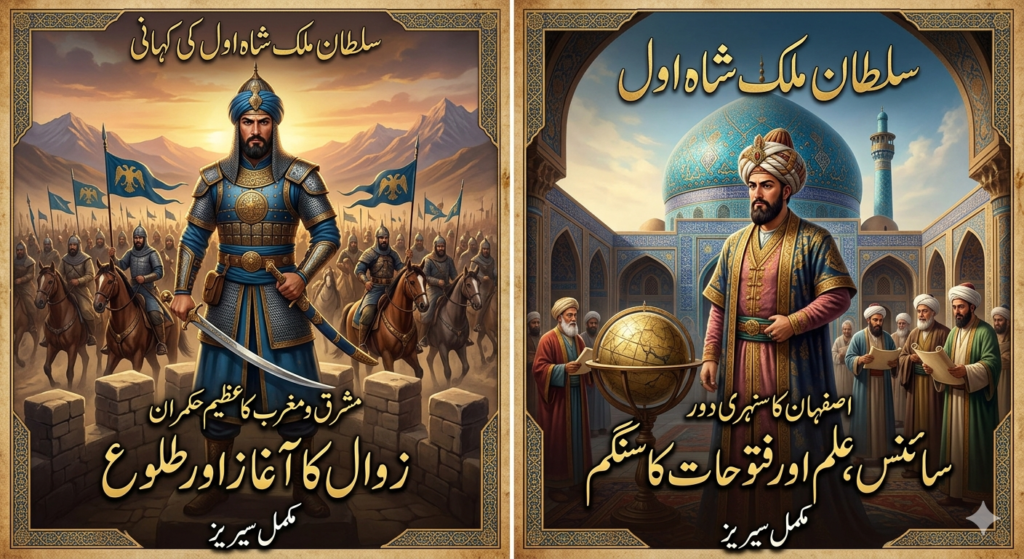
The Rise of the Heavenly Sultan
”The sword conquers the land, but the pen governs it. A Sultan without a wise Vizier is like a lion without claws.” — Ancient Seljuk Proverb. The Great Seljuk Empire: Sultan Malik Shah
Introduction: The Dawn of a New Era
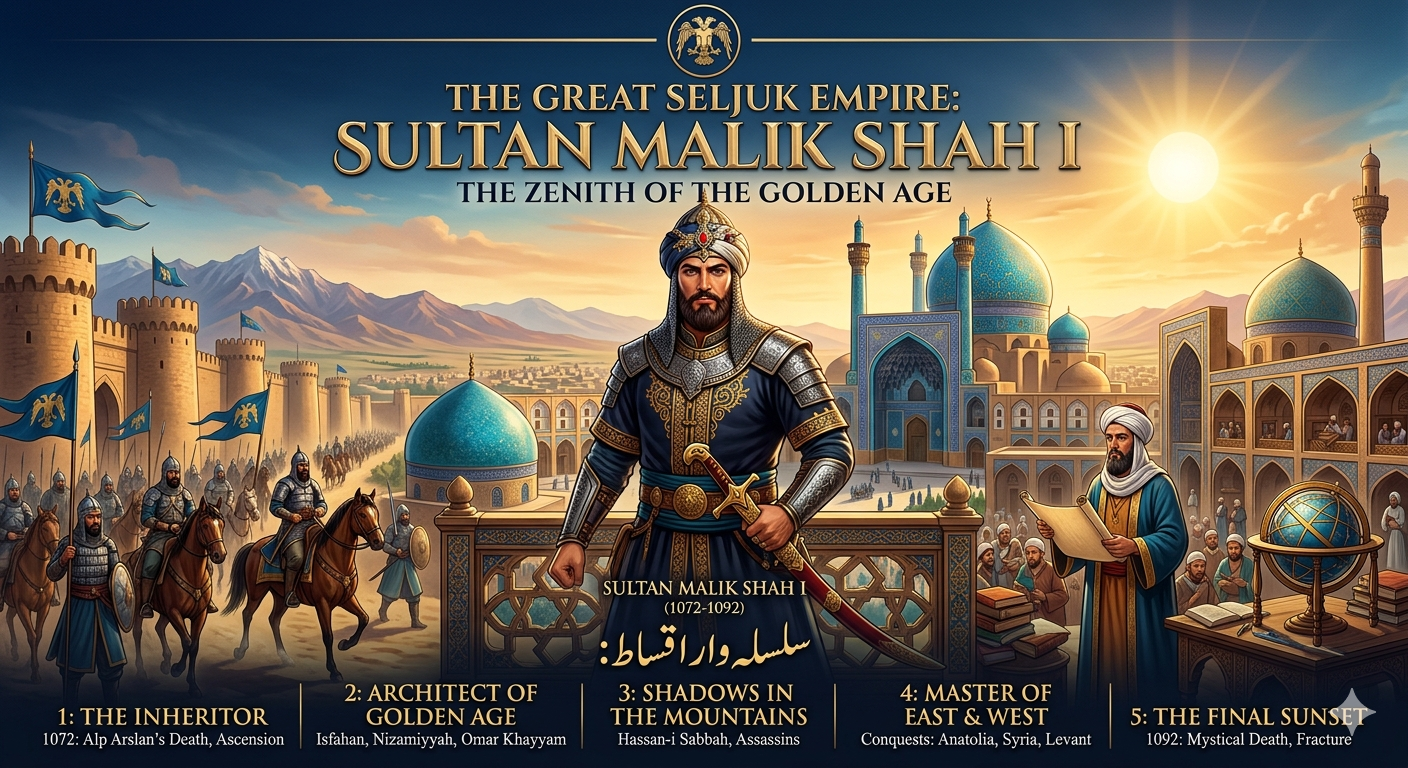
The history of Islam is adorned with names that resonate through the corridors of time, but few shine as brightly as Sultan Malik Shah I. Inheriting an empire that stretched across the heart of the world, The Great Seljuk Empire: Sultan Malik Shah was not merely a warrior-king but a visionary who turned the Seljuk Sultanate into the greatest superpower of the 11th century.The Great Seljuk Empire: Sultan Malik Shah
In this first episode, we delve into the dramatic ascension of the young prince and the blood-soaked struggle for the throne that defined the beginning of the “Golden Age” of the Great Seljuks.
1. The Legacy of the Lion: 1072 AD
The year 1072 marked a turning point in history. The legendary Sultan Alp Arslan, the victor of the Battle of Manzikert, was fatally wounded during a campaign in Transoxiana. As he lay on his deathbed, the fate of the Muslim world hung in the balance. The Great Seljuk Empire: Sultan Malik Shah
Alp Arslan summoned his eldest son, Abu’l-Fath Malik-Shah, then only 17 years old. Despite his youth, Malik Shah had already shown signs of the immense wisdom and military prowess that would later earn him the title “Jalal al-Dawla” (The Glory of the State). With his father’s final breath, the weight of a continent fell upon his shoulders.
2. The Internal Storm: The Rebellion of Qavurt Bey
No crown is placed without a challenge. In the Seljuk tradition, the law of succession was often written in blood. The young Sultan’s greatest threat came not from the Byzantines or the Crusaders, but from within his own family—his uncle, Qavurt Bey. The Great Seljuk Empire: Sultan Malik Shah
Qavurt, the veteran governor of Kerman, believed that according to ancient Turkic customs, the eldest member of the family should rule, not the son.
- The Conflict: Qavurt marched toward the capital, Rayy, with a formidable army of Turkmen tribesmen.
- The Stakes: If Malik Shah failed, the empire would have splintered into minor principalities, ending the dream of a unified Islamic Caliphate.
- The Battle of Hamadan: In 1073, the two forces clashed. It was a brutal test of loyalty. Malik Shah, supported by his brilliant Vizier Nizam al-Mulk, displayed tactical brilliance beyond his years.
3. The Architect of Power: Nizam al-Mulk Tusi
Every great Sultan has a shadow that guides him. For Malik Shah, that shadow was Nizam al-Mulk, one of the greatest statesmen in human history.
Nizam al-Mulk realized that for Malik Shah to rule effectively, the empire needed more than just a nomadic army; it needed a Bureaucratic Revolution. During the early days of Malik Shah’s reign, they established: The Great Seljuk Empire: Sultan Malik Shah
- The Nizamiyyah Madrasas: The first organized university system in the world.
- The Standing Army: Shifting from tribal militias to a professional, loyal military force.
- Intelligence Network: A sophisticated system of spies and couriers to monitor every corner of the realm.
4. Expansion: Beyond the Frontiers
Once the internal rebellions were crushed, Malik Shah turned his eyes toward the horizon. He was not content with just holding his father’s lands. Under his command, the Seljuk borders began to expand at an unprecedented rate. The Great Seljuk Empire: Sultan Malik Shah
- Anatolia: He encouraged the Turkoman tribes to settle in the newly conquered Roman lands, laying the foundation for what would eventually become the Sultanate of Rum.
- The Levant: His generals pushed into Syria and Palestine, bringing the holy cities closer to Seljuk protection.
- Central Asia: He subdued the Karakhanids, ensuring that the Silk Road trade routes were safe and prosperous.
5. The Symbolic Investiture
The ultimate legitimacy for a Muslim ruler at that time came from the Abbasid Caliph in Baghdad. In a grand ceremony, Caliph al-Muqtadi recognized Malik Shah as the “Sultan of the East and the West.” This was not just a title; it was a declaration. Malik Shah was now the official protector of the Islamic world, the commander of the faithful’s armies, and the guardian of the holy cities. The “Young Prince” had vanished, and in his place stood a World Conqueror. The Great Seljuk Empire: Sultan Malik Shah
Conclusion of Episode 1
As the dust of the civil war settled, Malik Shah I stood at the pinnacle of power. However, as the empire grew in wealth and size, new shadows were forming. In the dark corners of the mountains, a secret society known as the Assassins was beginning to plot, and the Vizier Nizam al-Mulk knew that the greatest battles were yet to come. The Great Seljuk Empire: Sultan Malik Shah
In the next episode: We explore the “Golden Age of Isfahan” and the intellectual revolution that brought together the greatest minds like Umar Khayyam under the banner of the Seljuks.
Conclusion of Episode 1As the dust of the civil war settled, Malik Shah I stood at the pinnacle of power. However, as the empire grew in wealth and size, new shadows were forming. In the dark corners of the mountains, a secret society known as the Assassins was beginning to plot, and the Vizier Nizam al-Mulk knew that the greatest battles were yet to come.In the next episode: We explore the “Golden Age of Isfahan” and the intellectual revolution that brought together the greatest minds like Umar Khayyam under the banner of the Seljuks. The Great Seljuk Empire: Sultan Malik Shah
The Architect of the Golden Age & The Shadow of Isfahan
“A kingdom can endure with unbelief, but it cannot endure with injustice.” — Nizam al-Mulk, Siyasatnama (The Book of Government).
The Zenith of Imperial Grandeur
The reign of Sultan Malik Shah I was not merely a sequence of military conquests; it was the era when the Islamic world reached its intellectual and cultural peak. While the first episode detailed his bloody ascent to the throne, Episode 2 explores how the “Heavenly Sultan” turned a nomadic warrior state into the most sophisticated superpower of the 11th century. The Great Seljuk Empire: Sultan Malik Shah
Under Malik Shah, the Seljuk Sun did not just burn with the heat of the sword—it shone with the light of science, trade, and law.
1. Isfahan: “Half of the World” (Nisf-e-Jahan)
Malik Shah moved the imperial capital to Isfahan, a city he intended to make the jewel of the East. Under his patronage, Isfahan underwent a transformation so radical that it earned the Persian title “Isfahan Nisf-e-Jahan” (Isfahan is half the world). The Great Seljuk Empire: Sultan Malik Shah
- The Great Mosque (Masjid-e-Jameh): The Sultan ordered the expansion of the congregational mosque, introducing the “Seljuk Dome”—a masterpiece of geometry that stands to this day.
- The Royal Gardens: He commissioned the Bagh-e-Karan, vast gardens that symbolized the Quranic vision of paradise, blending Persian aesthetics with Turkic grandeur.
- Economic Prosperity: By securing the Silk Road, Malik Shah ensured that Isfahan became the global center for silk, spices, and precious metals.
2. The Nizamiyyah Revolution: The Birth of the University
The Sultan’s greatest legacy was not built of stone, but of ideas. In partnership with his Grand Vizier, Nizam al-Mulk, he established the Nizamiyyah Madrasas. These were the world’s first organized, state-sponsored universities. The Great Seljuk Empire: Sultan Malik Shah
- Standardized Education: Before Nizamiyyah, education was informal. Now, students followed a structured curriculum in law, theology, and philosophy.
- The Baghdad Campus: The most famous branch in Baghdad hosted the legendary Imam al-Ghazali, who became the intellectual heartbeat of the empire.
- Welfare for Scholars: For the first time, students were provided with free housing, meals, and stipends, ensuring that talent—not wealth—dictated success.
3. The Scientific Renaissance: Omar Khayyam’s Legacy
Malik Shah was a man of deep curiosity. He invited the world’s greatest polymath, Omar Khayyam, to his court. While history remembers Khayyam for his poetry (the Rubaiyat), in Malik Shah’s court, he was the Sultan’s chief astronomer. The Great Seljuk Empire: Sultan Malik Shah
The Jalali Calendar (1079 AD)
The Sultan realized that the existing lunar and solar calendars were inaccurate for tax collection and agriculture. He commissioned an Imperial Observatory in Isfahan.
- The Result: The Jalali Calendar (named after Malik Shah’s title, Jalal al-Dawla). It was so precise that it has an error of only one day in every 5,000 years—making it more accurate than the Gregorian calendar used today.
4. The Administrative Genius: The Iqta System
Governing an empire that stretched from the borders of China to the Mediterranean required a revolutionary administrative touch. Malik Shah and Nizam al-Mulk perfected the Iqta System. The Great Seljuk Empire: Sultan Malik Shah
Instead of paying generals from a central treasury that could run dry, the Sultan granted them the right to collect revenue from specific lands. In exchange, the lords (Iqtadars) were responsible for maintaining a set number of professional cavalrymen. This ensured: The Great Seljuk Empire: Sultan Malik Shah
- A Standing Army was always ready for war.
- Agricultural Development: Lords were incentivized to make their lands fertile to increase their own revenue.
5. Expansion: The Master of Two Seas
While the Sultan focused on culture, his generals never stopped marching. Under his command, the Seljuk Empire achieved its greatest territorial extent: The Great Seljuk Empire: Sultan Malik Shah
- The Mediterranean Coast: Seljuk forces captured Antioch in 1084, pushing the Byzantine Empire further into a corner.
- The Holy Cities: He asserted authority over Mecca and Medina, becoming the first Seljuk to hold the title of protector of the Two Holy Mosques.
- The Caucasus: From Georgia to Armenia, local kings paid tribute to the Sultan, making him the undisputed “Sultan of the East and the West.”
6. The First Shadows: The Rise of the Assassins
Amidst this gold and glory, a dark thread was being woven. A former schoolmate of Nizam al-Mulk, a man named Hassan-i Sabbah, had broken away from the mainstream. He seized the mountain fortress of Alamut. The Great Seljuk Empire: Sultan Malik Shah
Hassan-i Sabbah began training a group of elite, secret warriors known as the Fida’iyyin (The Assassins). They didn’t use armies; they used poisoned daggers in the dark. As Malik Shah reached the peak of his power, these “Shadows of the Mountains” began their campaign of terror, targeting the Sultan’s closest advisors. The Great Seljuk Empire: Sultan Malik Shah
Conclusion: The Calm Before the Storm
By 1090 AD, Sultan Malik Shah I was the most powerful man on Earth. His empire was wealthy, his people were educated, and his borders were secure. But history teaches us that the brightest suns cast the darkest shadows. The conflict between the Sultan’s vision of order and the Assassins’ vision of chaos was about to explode.
The Hidden War & The Eagle of Alamut
”A king must be aware that his enemies do not always come with drums and banners; sometimes, they come as a shadow in the night and a whisper in the ear.” — Political Wisdom of the 11th Century.
The Golden Age Under Threat
By the mid-1080s, Sultan Malik Shah I had reached the absolute zenith of his power. His empire was the envy of the world, stretching from the borders of China to the gates of Constantinople. Trade flourished, the Nizamiyyah Madrasas were producing the greatest minds of Islam, and the streets of Isfahan were paved with the wealth of three continents. The Great Seljuk Empire: Sultan Malik Shah
However, beneath this veneer of gold and silk, a dark rot was beginning to spread. This was not a threat from the Byzantine legions or the Fatimid Caliphate. This was an internal cancer—a secret society that would change the course of history forever: The Hashashin (The Assassins). The Great Seljuk Empire: Sultan Malik Shah
1. The Rise of Hassan-i Sabbah: The Old Man of the Mountain
While Malik Shah was busy expanding the physical borders of the empire, a charismatic and radical figure named Hassan-i Sabbah was expanding a spiritual and political rebellion.
Hassan, a former classmate of the Vizier Nizam al-Mulk, had embraced a radical branch of Isma’ili thought. He realized he could never defeat the massive Seljuk army in an open field. Instead, he developed a terrifying new doctrine: Targeted Assassination. The Great Seljuk Empire: Sultan Malik Shah
- The Fortress of Alamut: In 1090, through a mix of cunning and bribery, Hassan-i Sabbah seized the impregnable castle of Alamut in the Alborz Mountains.
- The Eagle’s Nest: From this “Eagle’s Nest,” he began training his Fida’is—young men fanatically devoted to him, willing to die to eliminate the enemies of their order.
2. The Sultan’s Dilemma: Shadow vs. Steel
Sultan Malik Shah initially viewed Hassan-i Sabbah as a minor nuisance—a rebel in a faraway castle. But Nizam al-Mulk, the wise Vizier, saw the danger. He understood that these were not ordinary rebels; they were a state within a state. The Great Seljuk Empire: Sultan Malik Shah
Nizam al-Mulk urged the Sultan to take immediate military action. Malik Shah dispatched several expeditions to besiege Alamut. However, the fortress was built on a sheer cliff, and the Assassins had stockpiled years of supplies. Every Seljuk attempt to storm the gates ended in failure. The Sultan’s steel was useless against the mountain’s shadow. The Great Seljuk Empire: Sultan Malik Shah
3. The Psychological War: A Dagger in the Pillow
The war between Malik Shah and Hassan-i Sabbah became psychological. The Assassins didn’t just kill; they spread terror. The Great Seljuk Empire: Sultan Malik Shah
History records that Malik Shah once sent a messenger to Alamut demanding Hassan’s surrender. Hassan, in front of the messenger, pointed to a young guard and ordered him to jump off the cliff. Without a second thought, the guard leaped to his death. Hassan then looked at the messenger and said: The Great Seljuk Empire: Sultan Malik Shah
”Tell your Sultan that I have 70,000 men like this. Let him come for us.”
There are legends that Malik Shah once woke up in his heavily guarded palace in Isfahan to find a poisoned dagger pinned to his pillow with a note that read: “What is far from you is closer than you think.” The message was clear: no one, not even the Sultan of the East and West, was safe.
4. The Intellectual Shield: Imam al-Ghazali
Sultan Malik Shah realized that the battle against the Assassins was not just military—it was a battle of ideas. To counter the radical ideology of the Batinis (Assassins), the Sultan and Nizam al-Mulk empowered the greatest scholar of the age: Imam al-Ghazali. The Great Seljuk Empire: Sultan Malik Shah
Al-Ghazali was appointed as the head of the Nizamiyyah in Baghdad. He wrote “The Incoherence of the Philosophers” and other works to strengthen the Sunni orthodoxy of the Seljuk state. This “Soft Power” was Malik Shah’s way of ensuring the hearts of his people remained loyal even as fear gripped the elite. The Great Seljuk Empire: Sultan Malik Shah
5. The Expansion of 1091: The Conquest of the Seas
Despite the internal threat, Malik Shah’s military machine did not stop. In one of the most iconic moments of his reign, the Sultan led his cavalry to the shores of the Mediterranean Sea.
- Symbolic Victory: It is said that Malik Shah rode his horse into the waves, drew his sword, and thanked Allah for allowing him to reach the “Western Sea.”
- The Three Oceans: For a brief moment, the Seljuk Sultanate controlled the routes to the Indian Ocean, the Persian Gulf, and the Mediterranean. He was truly the master of the world’s trade.
Conclusion of Episode 3
By the year 1092, Sultan Malik Shah I was at the absolute peak of human glory. But the higher the sun rises, the closer it is to setting. The tensions between the aging Vizier Nizam al-Mulk and the Sultan’s younger wife, Terken Khatun, were beginning to boil over. The Great Seljuk Empire: Sultan Malik Shah
The Sultan was caught between the man who built his empire and the woman who wanted to secure the future for her son. And in the shadows, the Assassins were finally ready to strike their most devastating blow.
In the next episode: The Fall of the Pillars — The tragedy of Nizam al-Mulk and the mysterious end of the Great Sultan. The Great Seljuk Empire: Sultan Malik Shah
The Master of the East and West
“The Sultan is the Shadow of God on Earth, in whom every oppressed person finds refuge.” — The Seljuk Imperial Motto.
The Unchallenged Hegemony
By the mid-1080s, the Great Seljuk Empire was no longer just a state; it was a global civilization. Sultan Malik Shah I had successfully integrated the fierce warrior spirit of the Oghuz Turks with the administrative brilliance of the Persians and the spiritual legitimacy of the Arabs. The Great Seljuk Empire: Sultan Malik Shah
In this fourth installment, we explore the period known as the “Great Peace” (Pax Seljuka), where Malik Shah’s influence reached such heights that even the Roman Emperors and the Caliphs of Baghdad bowed to his strategic genius.
1. The Sultan and the Caliph: A Power Dynamic
While the Sultan held the sword, the Abbasid Caliph al-Muqtadi held the spiritual mantle of Islam in Baghdad. The relationship between the two was a delicate dance of diplomacy and power. The Great Seljuk Empire: Sultan Malik Shah
- The Royal Marriage: To solidify his grip on the heart of the Islamic world, Malik Shah married his daughter to the Caliph. This was not just a family union; it was a political masterstroke intended to eventually merge the Seljuk bloodline with the Caliphate.
- The Protectorate: Malik Shah visited Baghdad with a magnificent entourage. He spent vast sums of gold to renovate the city’s infrastructure, build the Jameh Sultan Mosque, and ensure that the Seljuk presence was felt in every street of the Abbasid capital.
- The New Hierarchy: For the first time in history, the Sultan was not just a military commander; he was the de facto ruler of the Islamic world, while the Caliph remained a symbolic figurehead.
2. The Transcontinental Empire: From Kashgar to the Levant
Malik Shah’s military campaigns in this era were not just about conquest, but about Stabilization. He traveled thousands of miles on horseback, personally overseeing the security of his vast frontiers. The Great Seljuk Empire: Sultan Malik Shah
The Eastern Frontier (Transoxiana)
Malik Shah marched into Central Asia to discipline the Karakhanids. Instead of destroying them, he turned them into loyal vassals. By doing so, he secured the frontiers against nomadic incursions from the deep Steppes, ensuring that the Silk Road remained an uninterrupted highway of wealth. The Great Seljuk Empire: Sultan Malik Shah
The Western Frontier (The Byzantine Border)
While the Sultan managed the heartland, his generals—most notably Suleiman ibn Qutulmish—pushed deep into the Anatolian plateau.
- The Birth of Rum: This era saw the establishment of the Sultanate of Rum in Anatolia. Though semi-independent, they looked to Malik Shah as their supreme overlord.
- The Capture of Jerusalem: Under Malik Shah’s authority, the Seljuk commanders took control of the Holy City of Jerusalem from the Fatimids, a move that would later trigger the Western world’s focus on the Crusades.
3. The “Post-Master” General: The Barid System
How did Malik Shah manage an empire so large that it took six months to cross? He revived and perfected the Barid (Postal and Intelligence System). The Great Seljuk Empire: Sultan Malik Shah
- State-of-the-Art Communications: A network of relay stations was built every few miles. Couriers on fast horses could carry a message from the borders of China to the city of Isfahan in a fraction of the usual time.
- The Sultan’s Ears: This system wasn’t just for letters; it was for intelligence. Malik Shah knew about a local governor’s corruption or a peasant’s rebellion before the news even reached the local markets.
4. The Grand Architect: Building a Legacy in Stone
Malik Shah’s wealth was legendary. Historical chronicles state that the Sultan’s treasury was so full that he abolished many taxes on the common people. He redirected this wealth into Massive Public Works: The Great Seljuk Empire: Sultan Malik Shah
- Caravanserais: He built “Fortress-Hotels” along the Silk Road every 30 kilometers. These provided free food and protection for merchants, boosting international trade to record levels.
- Bridges and Dams: To support agriculture, he commissioned irrigation projects in the arid regions of Persia and Iraq, turning deserts into gardens.
- The Imperial Mint: He standardized the Seljuk Dinar, making it one of the most trusted currencies in the world, accepted from the markets of Cairo to the ports of Byzantium.
5. A Personal Portrait: The Man Behind the Legend
Contemporary historians describe Malik Shah not as a tyrant, but as a just and approachable ruler. He was known for: The Great Seljuk Empire: Sultan Malik Shah
- The Love of the Hunt: Like his father, he was a master archer. It is said he killed thousands of wild animals during his expeditions but always gave the meat to the poor as charity.
- Religious Tolerance: While a staunch Sunni, he ensured that his Christian and Jewish subjects were protected, following the Quranic principle of “No compulsion in religion,” which kept the empire stable and free of internal religious wars.
Conclusion: The Illusion of Immortality
As the year 1092 approached, Malik Shah I had reached the absolute summit of human power. He had no rivals left on the battlefield, his treasury was overflowing, and his name was mentioned in the Friday sermons from the mosques of China to the borders of Europe. The Great Seljuk Empire: Sultan Malik Shah
But as the Sultan prepared for his final journey to Baghdad, a cold wind was blowing from the mountains of Alamut. The Assassins had marked their target. The Golden Age was about to face its most terrifying trial—one that no army could stop The Great Seljuk Empire: Sultan Malik Shah
The Final Sunset – The Fall of the Giants
“The world is a caravan serai with two gates: through one, we enter, and through the other, we depart. Not even a Sultan can stay forever.” — Attributed to the Seljuk Era.
The Peak Before the Descent
By 1092 AD, the Great Seljuk Empire had become the undisputed center of the world. Sultan Malik Shah I was at the height of his majesty, and his Grand Vizier, Nizam al-Mulk, had governed the realm with an iron hand and a brilliant mind for thirty years. However, beneath the surface of this glittering golden age, the cracks of destiny were beginning to widen. The Great Seljuk Empire: Sultan Malik Shah
In this final episode, we witness the dramatic and mysterious end of the two men who defined an era, and how their departure led to the fracturing of the greatest empire of the Middle Ages.
1. The Growing Rift: Sultan vs. Vizier
Even the strongest alliances can be weakened by time and whispers. In the final years, the relationship between Malik Shah and Nizam al-Mulk began to strain. The Great Seljuk Empire: Sultan Malik Shah
- The Court Intrigues: Queen Terken Khatun, the Sultan’s powerful wife, sought to secure the succession for her young son, Mahmud. However, Nizam al-Mulk favored the elder son, Barkiyaruq.
- The Power Struggle: Terken Khatun constantly whispered in the Sultan’s ear that the Vizier had become too powerful—that his “Nizamiyyah” network was a state within a state.
- The Famous Ultimatum: Legend says Malik Shah sent a message to the Vizier, threatening to remove his inkstand (symbol of office). Nizam al-Mulk famously replied: “The Sultan’s crown and my inkstand are tied together. If you take one, the other will surely fall.” These words proved to be a haunting prophecy.
2. The Dagger in the Dark: The Death of Nizam al-Mulk
In October 1092, while the imperial court was traveling from Isfahan to Baghdad, the “Shadows of Alamut” finally struck. The Great Seljuk Empire: Sultan Malik Shah
As Nizam al-Mulk was being carried in his litter after the evening prayer, a man dressed as a Sufi dervish approached him, claiming to have a petition. As the Vizier reached out to take the paper, the assassin drew a poisoned dagger and plunged it into the heart of the Great Vizier.
Nizam al-Mulk, the architect of the Seljuk Golden Age and the author of the Siyasatnama, died shortly after. His death sent shockwaves through the Muslim world. The “Inkstand” had fallen. The Great Seljuk Empire: Sultan Malik Shah
3. The Mysterious End of Sultan Malik Shah I
The Sultan was devastated, yet he continued his journey to Baghdad. He was now the sole ruler, free from the shadow of his mentor but also without his greatest protector.
Within just weeks of Nizam al-Mulk’s assassination, the unthinkable happened. In November 1092, after a hunting expedition near Baghdad, the 37-year-old Sultan suddenly fell illThe Great Seljuk Empire: Sultan Malik Shah
- The Mystery: Some historians suggest it was a sudden fever, while many others believe he was poisoned by the same forces that killed his Vizier—or perhaps by factions within his own palace.
- The Passing: Sultan Malik Shah I, the “Sultan of the East and West,” breathed his last in Baghdad. He was buried in Isfahan, the city he had turned into a paradise on earth.
4. The Great Fracture: The Empire Divided
The death of Malik Shah was the “Great Fitna” (Chaos) of the Seljuks. Because he had not clearly solidified his successor before his sudden death, the empire erupted into a brutal civil war. The Great Seljuk Empire: Sultan Malik Shah
- The Sons’ War: Barkiyaruq, Muhammad I, and Ahmad Sanjar fought for decades over the throne.
- The Rise of Local Dynasties: Atabegs (governors) in Syria and Anatolia began to declare independence, realizing there was no longer a “Great Sultan” in Isfahan to stop them.
- The First Crusade: It was this internal Seljuk weakness that allowed the First Crusaders from Europe to capture Jerusalem in 1099. Had Malik Shah been alive, the history of the Crusades might have been very different.
5. The Eternal Legacy of Malik Shah I
Though the empire eventually fractured, the impact of Malik Shah’s twenty-year reign changed history forever: The Great Seljuk Empire: Sultan Malik Shah
- Intellectual Foundation: The Nizamiyyah schools he built preserved Islamic knowledge and produced scholars like Al-Ghazali, who shaped Islamic thought for a thousand years.
- Cultural Identity: He successfully blended Turkic bravery with Persian culture, creating the “Turko-Persian” identity that would later influence the Ottoman, Safavid, and Mughal Empires.
- Architectural Blueprint: From the domes of Isfahan to the caravanserais of the Silk Road, his buildings set the standard for Islamic architecture.
Final Thoughts for the Reader
Sultan Malik Shah I was perhaps the last ruler to hold the entire heart of the Muslim world under one banner. He was a man of the sword, a patron of the stars, and a builder of cities. While his empire eventually faded, the “Golden Age” he created remains a testament to what is possible when power is guided by wisdom and justice. The Great Seljuk Empire: Sultan Malik Shah
The Sun of the Seljuks had set, but its warmth would be felt for centuries to come.
Web Admin Note: This concludes the 5-part series on Sultan Malik Shah I. This final part is designed to be highly engaging and “sharable” on social media. The Great Seljuk Empire: Sultan Malik Shah