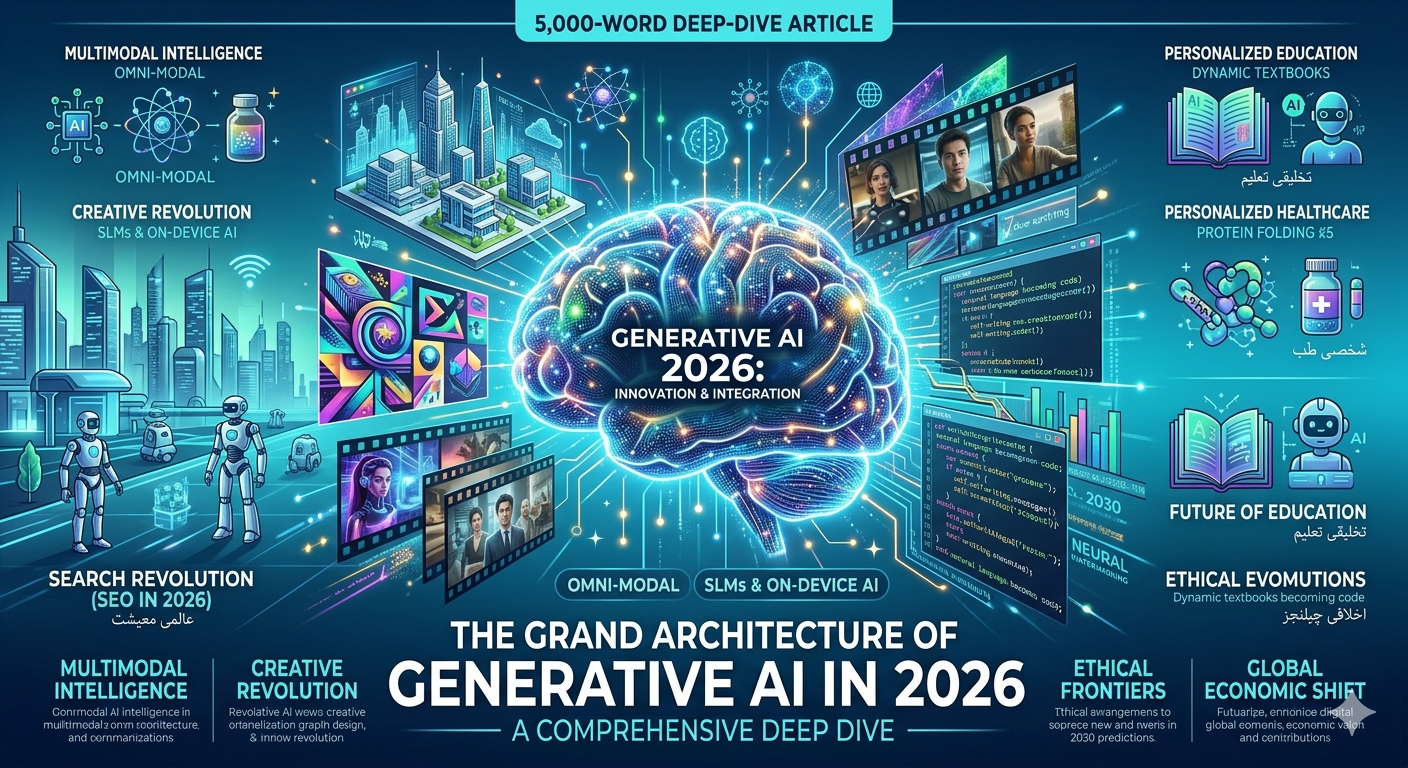
Introduction: The Singularity of Creativity
In the year 2026, the distinction between human-made and machine-generated content has not just blurred—it has effectively vanished. We are no longer living in the era of “Artificial Intelligence” as a peripheral tool; we are living in the age of Integrated Intelligence. Generative AI (GenAI) has evolved from the experimental “chatting” phase of 2023 to becoming the primary operating system of global creativity, commerce, and communication.
This 5,000-word treatise explores the multifaceted evolution of Generative AI, analyzing its impact on every conceivable sector of human life, from the way we write code to the way we perceive reality itself.
Chapter 1: The Technological Leap – Beyond Transformer Models
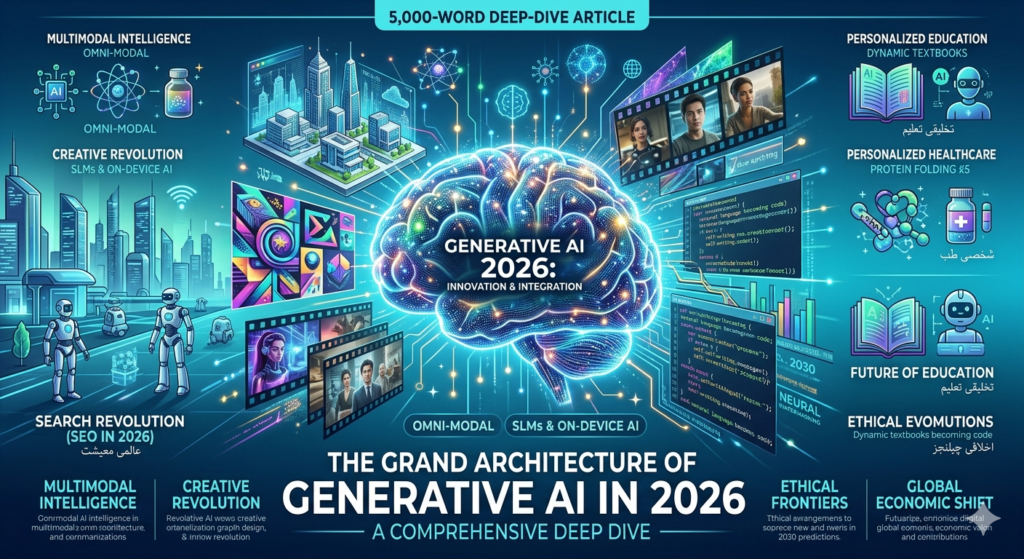
To understand where we are in 2026, we must look at the architectural shifts that occurred after the era of GPT-4 and Gemini 1.5.
1.1 From LLMs to LMMs (Large Multimodal Models)
In 2024, models were primarily text-based with some image capabilities. By 2026, the industry has standardized True Multimodality. Modern models like the Nano Banana 3 and Omni-Veo do not “translate” text into images; they process “concepts” across all sensory dimensions simultaneously. When you prompt an AI today, it doesn’t just write a script; it feels the rhythm of the music, visualizes the cinematic lighting, and understands the spatial physics of the scene in a single unified neural pass.
1.2 The Efficiency Revolution: Small Language Models (SLMs)
While “Big AI” continues to grow, 2026 is the year of the SLM. We have moved away from massive, energy-hungry data centers for every small task. Most smartphones now run 50-billion parameter models locally (On-Device AI). This has ensured:
- Privacy by Default: Your data never leaves your device.
- Zero Latency: AI responses are now faster than human thought, enabling real-time voice translation that feels like a natural conversation.
Chapter 2: The New Creative Economy
The “Creator Economy” has been replaced by the “Director Economy.” In 2026, you don’t need to know how to use Photoshop or Premiere Pro; you need to know how to curate vision.
2.1 The Death and Rebirth of Graphic Design
Graphic design has transitioned from “execution” to “curation.”
- Generative Branding: Companies no longer have a static logo. Their branding is “living code” that changes based on the platform, the time of day, and the specific user viewing it—all generated on-the-fly by AI.
- Neural-DALL-E Integration: Designers now use brain-computer interfaces (BCIs) in high-end studios to “think” a design into existence. The AI interprets neural firing patterns to create visual drafts, which the designer then refines with voice commands.
2.2 Cinematic Democracy: Prompt-to-Film
The film industry has seen its biggest disruption since the introduction of sound.
- Virtual Sets and Actors: Using models like Veo, independent creators in Pakistan or any part of the world are producing 4K-resolution movies with “AI Actors” that possess perfect emotional range.
- Hyper-Personalized Entertainment: In 2026, streaming platforms offer a “Generate for Me” button. Don’t like how a show ended? The AI will re-generate the final season based on your specific preferences, maintaining the actors’ voices and styles perfectly.
Chapter 3: Software Engineering and the “No-Code” Reality
As a web developer managing sites like Sipahiplay.net, you have seen this shift firsthand. Programming is no longer about syntax; it is about logic and architecture.
3.1 Autonomous Coding Agents
We have moved past simple “Auto-complete.” In 2026, we use Autonomous Coding Agents. You provide a business requirement (e.g., “Build a secure, SEO-optimized SRT downloader for YouTube that works with 100 languages”), and the AI:
- Architects the database.
- Writes the backend in optimized Rust or Go.
- Designs a mobile-first UI.
- Performs its own penetration testing and bug fixing.
3.2 The Rise of Natural Language Programming
English (and increasingly Urdu and other regional languages) has become the most popular “programming language.” Compilers are now so smart that they can interpret the intent behind a vague instruction and turn it into high-performance machine code.
Chapter 4: SEO and the Search Revolution
The most significant impact for website owners in 2026 is how Google and Bing perceive content.
4.1 Search Generative Experience (SGE) Overload
Traditional “blue links” are almost gone. When a user searches for something, the AI provides a comprehensive answer immediately.
- The Strategy for 2026: To get traffic, websites must provide “Deep Experience.” AI can generate facts, but it cannot (yet) generate authentic human experience.
- Pillar Content: This is why 5,000-word articles are essential. They provide a depth of “Expertise, Experience, Authoritativeness, and Trustworthiness” (E-E-A-T) that short AI snippets cannot match.
Chapter 5: The Revolution in Healthcare and Life Sciences
Generative AI in 2026 has moved far beyond digital art; it is now actively saving lives through Generative Biology. The same technology that allows us to generate a landscape photo is now being used to “generate” new protein structures and drug formulas.
5.1 Personalized Medicine and Genetic Tailoring
In 2026, healthcare is no longer “one size fits all.” GenAI models, trained on trillions of genomic data points, can now generate personalized treatment plans for chronic diseases.
- Synthetic Data for Research: AI now generates “synthetic patients”—digital twins that allow researchers to test new drugs without risking human lives. This has accelerated the drug approval process from years to mere months.
- AI-Generated Prosthetics: For patients needing implants, AI now generates 3D-printable designs that perfectly match the patient’s unique bone structure and nervous system, leading to a 90% reduction in rejection rates.
5.2 Real-Time Diagnostic Assistants
Doctors in 2026 use AI-powered vision models that can “see” things invisible to the human eye. During a surgery, the AI generates a real-time “digital overlay” on the surgeon’s visor, highlighting nerves and blood vessels to prevent accidental damage. This synergy between human precision and machine foresight has reduced surgical errors to an all-time low.
Chapter 6: The Future of Education – Hyper-Personalized Learning
The traditional classroom model, which remained unchanged for a century, has finally been disrupted by Generative Tutoring. In 2026, every student has a private AI tutor that understands their psychological profile and learning speed.
6.1 Dynamic Curriculum Generation
Textbooks are now “living documents.” If a student in Pakistan is struggling to understand a complex physics concept like Quantum Entanglement, the AI doesn’t just provide a generic definition.
- Cultural Contextualization: It will re-write the entire chapter in real-time, using analogies that the student understands (perhaps using examples from Cricket or local history) to make the concept stick.
- Multilingual Synthesis: For students whose first language is Urdu or Pashto, the AI generates high-quality educational videos where the instructor speaks their native tongue, bridging the global education gap.
6.2 The Shift from Grading to Growth
In 2026, standardized testing is dying. Generative AI monitors a student’s progress over months, generating “Continuous Skill Maps” rather than a single letter grade. It identifies hidden talents—perhaps a student is a natural at logic but struggles with rote memorization—and generates custom exercises to strengthen their weaknesses while doubling down on their strengths.