
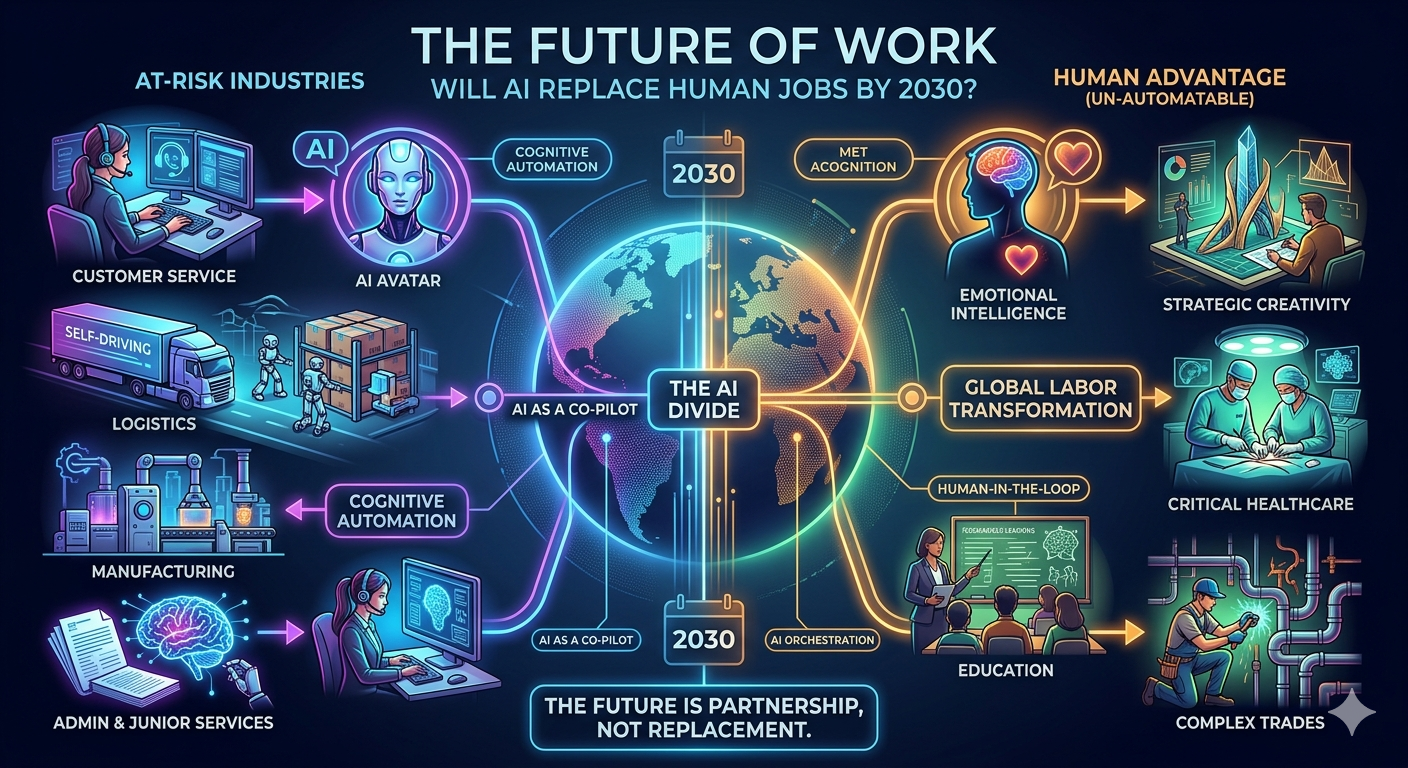
Introduction: The Great Labor Transformation
As we cross the mid-point of 2026, the global workforce is standing at a historical crossroads. The rapid integration of Generative AI, robotics, and autonomous systems has sparked a debate that echoes the industrial revolutions of the past: Will machines eventually make human labor obsolete?
By 2030, the landscape of “work” will be unrecognizable compared to the early 2020s. This is not just about automation; it is about the fundamental shift in how value is created, distributed, and rewarded. This 5,000-word deep dive examines the sectors most at risk, the emergence of new career paths, and the strategic roadmap humans must follow to remain indispensable in an AI-driven economy.
Chapter 1: The Automation Paradox – Why 2030 is Different
In previous technological shifts—like the invention of the steam engine or the personal computer—physical tasks were automated, but human cognitive roles expanded. However, the AI revolution of the 2020s is targeting cognitive labor.
1.1 The Velocity of Change
Unlike the slow adoption of the internet, AI models like Gemini and GPT-5 have reached a state of “Recursive Improvement.” The AI is now helping to build better AI, leading to an exponential growth curve. By 2030, tasks that were considered “uniquely human”—such as complex legal research, medical diagnosis, and even creative writing—will be handled by algorithms with 99% accuracy.
1.2 Cost Efficiency vs. Human Labor
In a globalized economy, the primary driver for AI adoption is the “Economic Equilibrium.” An AI agent can work 24/7, requires no health benefits, and improves with every second of operation. For corporations, the transition to AI isn’t just a tech upgrade; it is a fiduciary necessity to remain competitive.
Chapter 2: High-Risk Industries: The Frontlines of Automation
By 2030, several industries will see a massive reduction in human headcount. Understanding these “at-risk” zones is crucial for career planning.
2.1 Customer Service and Administration
The days of traditional call centers are numbered. By 2030, AI avatars with perfect emotional intelligence will handle 95% of customer interactions.
- The Shift: Administrative roles like data entry, scheduling, and basic bookkeeping will be entirely autonomous. Humans in these sectors will transition to “Experience Managers,” focusing only on the most complex emotional escalations.
2.2 Manufacturing and Logistics
With the convergence of AI and advanced robotics, the factory floor of 2030 will be “Lights-Out” manufacturing.
- Autonomous Supply Chains: From self-driving trucks to AI-managed warehouses, the entire movement of goods will require minimal human intervention. The focus for humans will shift to “System Architecture” and “Robotic Maintenance.”
2.3 Junior Professional Services
Junior lawyers, junior analysts, and entry-level coders are facing a significant challenge. AI can now scan millions of documents or write thousands of lines of code in seconds.
- The Reality: The “entry-level” job as we know it is disappearing. Professionals starting their careers in 2026 must focus on high-level strategy and AI orchestration from day one.
Chapter 3: The Indispensable Human – Skills AI Cannot Replicate
While AI can simulate logic, it cannot replicate the biological and social complexities of the human experience. These are the “safe havens” for the 2030 workforce.
3.1 Emotional Intelligence (EQ) and Empathy
AI can say “I’m sorry,” but it cannot feel empathy. Roles that require deep human connection—such as social work, palliative care, high-stakes negotiation, and primary education—will remain human-centric.
3.2 Strategic Creativity and “The Spark”
AI is a master of “recombination”—taking existing data and making something new. However, it lacks “Original Intuition.” The ability to envision a completely new business model, a new social movement, or a groundbreaking artistic style remains a human domain.
3.3 Complex Physical Manipulation
Surprisingly, the job of a plumber or an electrician is safer from AI than the job of a data analyst. The physical world is chaotic and unpredictable. Developing a robot that can navigate a cluttered basement or fix a unique electrical leak in an old house is still a decade away from being cost-effective compared to human skill.
Chapter 4: The Emergence of Post-AI Careers
History shows that for every job destroyed by technology, new ones are created. By 2030, we will see job titles that don’t exist today.
4.1 AI Ethicists and Bias Auditors
As AI makes more life-altering decisions, we will need humans to ensure those decisions are fair and ethical. This will be a massive industry involving legal, social, and technical expertise.
4.2 Prompt Architects and Orchestrators
The most valuable skill of 2030 will be “Communication with Machines.” Prompt engineering will evolve into System Orchestration, where humans manage fleets of AI agents to achieve massive goals.
Chapter 5: The Economic Shift – From Labor to Capital
By 2030, the global economy will move from being “Labor-Centric” to “Compute-Centric.” In this new world, wealth is generated not by the number of hours worked, but by the efficiency of the AI algorithms one controls.
5.1 The De-globalization of Service Work
For decades, high-income countries outsourced service and technical work to lower-income regions. AI is reversing this trend. When an AI can handle coding or customer support for a fraction of the cost of offshore labor, companies will “re-shore” their operations.
- The Challenge for Emerging Markets: Countries that relied on “labor arbitrage” must pivot quickly. The goal is no longer to provide cheap labor but to provide AI-augmented expertise.
5.2 Universal Basic Income (UBI) and the Social Contract
If AI replaces 30% of human roles by 2030, governments will face a crisis of consumption. If people don’t have jobs, they can’t buy products.
- The Solution: We are seeing the early trials of Sovereign Wealth Funds where AI-driven productivity is taxed to provide a basic income for displaced workers. The debate in 2030 will not be “if” we need UBI, but “how” to implement it without destroying human motivation.
Chapter 6: The Survival of the Technical Class (Web Developers & Engineers)
Many fear that AI will “kill” coding. The reality is more nuanced: AI will kill the “syntax-writer,” but it will empower the “Architect.”
6.1 The Transition from Coder to Orchestrator
In 2026, you might spend hours fixing a CSS bug. By 2030, you will describe the entire user experience to an AI agent that generates the perfect, bug-free code instantly.
- Your New Role: You are the Product Owner. You manage the vision, the security protocols, and the user psychology. The AI handles the “bricks and mortar” of the code; you design the “Skyscraper.”
6.2 Full-Stack is Now “One-Man-Studio”
Because AI handles the heavy lifting of backend logic and frontend design, a single developer can now do the work that previously required a team of ten. This is the era of the “Super-Generalist.” To survive, developers must learn “Prompt Architecture” and “Systems Integration” rather than just memorizing frameworks like React or Next.js.
Chapter 7: Education and Re-skilling for the AI Age
The educational system of 2030 has finally moved away from rote memorization. Since AI knows all the facts, the value of a human degree is now based on Metacognition—the ability to learn how to learn.
7.1 Micro-Credentials vs. Traditional Degrees
A 4-year degree is too slow for the AI age. By the time you graduate, the technology has changed twice. The 2030 workforce relies on Stackable Micro-Credentials—intense, 3-month AI-driven certifications that prove you can handle current-gen tools.
7.2 The Rise of Vocational Mastery
As mentioned earlier, physical trades (Plumbing, Electrical, Specialized Construction) are seeing a resurgence in prestige and pay. High-school graduates in 2030 are increasingly choosing trade schools over liberal arts degrees, recognizing that physical skill is the ultimate “un-automatable” asset.
Chapter 8: Geopolitical Impact – The AI Divide
The gap between “AI-Ready” nations and “AI-Lagging” nations will define the geopolitics of 2030.
8.1 Strategic Autonomy
Nations that own their “Compute” (the hardware and the data centers) will dictate the terms of global trade. We are seeing a “Digital Iron Curtain” where countries must choose which AI ecosystem to join. For a professional in Pakistan, this means mastering Open Source AI models to ensure independence from any single global corporation.