Introduction: The Admiral Who Turned the Sea into an Empire
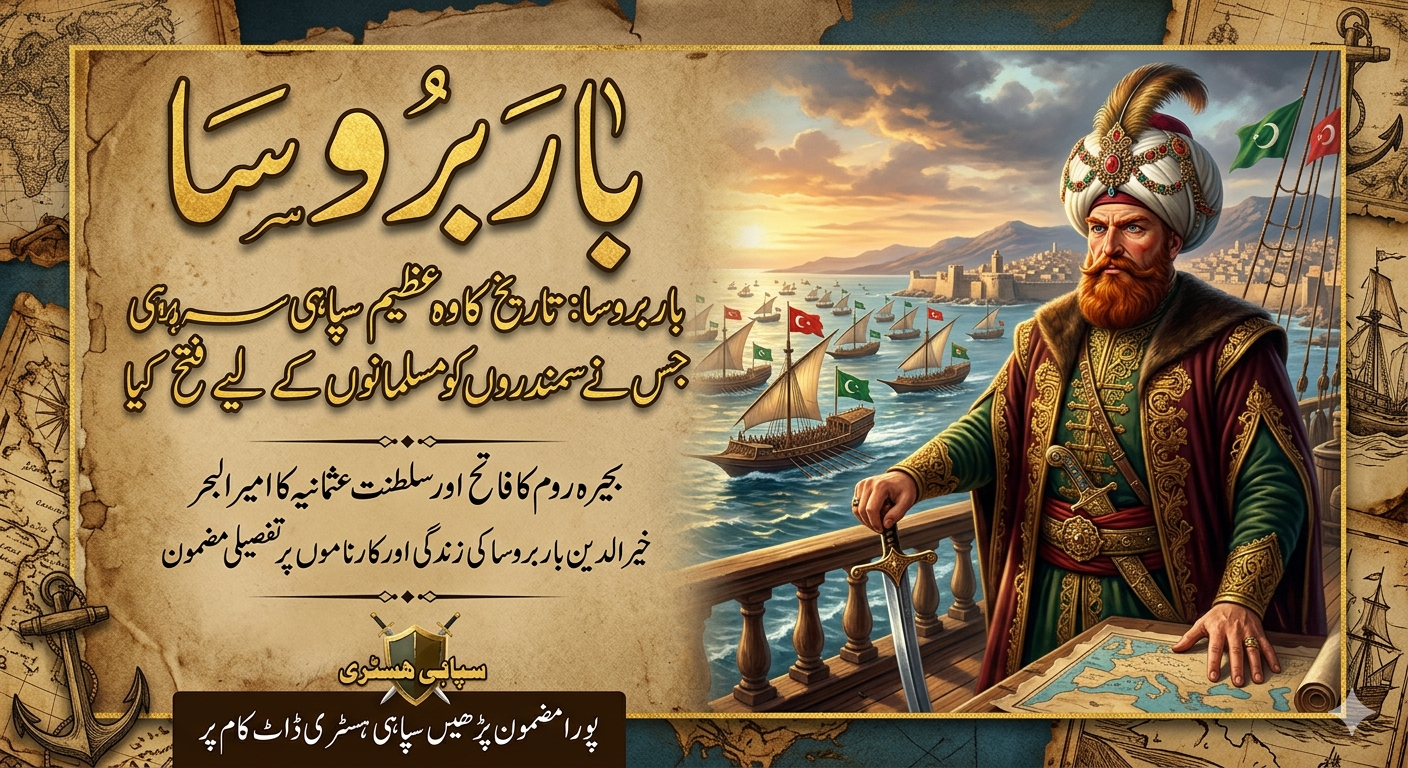
History is often written on land, but the destiny of the 16th century was decided on the waves of the Mediterranean. At the heart of this maritime revolution stood one man: Khizr Reis, known to the West as Barbarossa and to the Islamic world as Hayreddin Pasha. He was not merely a sailor or a pirate; he was a visionary strategist, a liberator of the oppressed, and the architect of Ottoman naval supremacy. For over thirty years, no ship could cross the Mediterranean without his permission. This is the story of a potter’s son who rose to become the Grand Admiral of the greatest empire on Earth.
Chapter 1: The Forge of the Aegean (Origins and Brotherhood)
The legend begins on the island of Lesbos (Midilli) shortly after its conquest by the Ottoman Sultan Mehmed the Conqueror. Born to Yakup Aga, a retired Ottoman Sipahi, Khizr was the youngest of four brothers: Ishak, Oruc, and Ilyas.
The brothers did not start as warriors. They were merchants, trading silk, spices, and ceramics between Lesbos, Thessaloniki, and Anatolia. However, the Mediterranean was a “War Zone” between the Ottoman Empire and the Knights of Saint John (Knights of Rhodes).
The Catalyst for Change
The turning point came during a trade voyage to Tripoli. The brothers were attacked by the Knights of Rhodes. Ilyas was killed in the skirmish, and Oruc was taken captive, forced to work as a galley slave in the dark hulls of the Knights’ ships. For years, Khizr worked tirelessly to locate and eventually rescue his brother. This personal tragedy transformed their merchant hearts into those of warriors. They realized that to survive, they had to move from defense to offense.
Chapter 2: The Birth of the “Red Beard” (The Corsair Era)
Oruc and Khizr moved their base of operations to North Africa, specifically to the port of La Goulette in Tunisia, under the protection of the Sultan of Tunis. From here, they began their campaign against Spanish and Italian shipping.
The Origin of the Name
It was during this period that Oruc began to be called Barbarossa (Italian for “Red Beard”). However, for the Muslims of Al-Andalus (Spain), he was “Baba Oruc” (Father Oruc). This was because of his humanitarian missions. Following the fall of Granada, the Spanish Inquisition was persecuting Muslims and Jews. The Barbarossa brothers used their fleet to transport thousands of refugees from the coast of Spain to the safety of North Africa.
The Fall of Algiers
In 1516, the people of Algiers, tired of Spanish tyranny, asked the brothers for help. Oruc and Khizr liberated the city. Oruc declared himself the Sultan of Algiers, effectively creating a new state. However, the Spanish did not take this lightly. In 1518, during the defense of Tlemcen, Oruc and Ishak were martyred. Khizr was left alone to face the might of the Habsburg Empire.
Chapter 3: The Alliance with the Sublime Porte
Realizing that Algiers could not survive as an isolated city-state against the Holy Roman Emperor Charles V, Khizr made a brilliant diplomatic move. He sent an envoy to the Ottoman Sultan, Selim I, offering the kingdom of Algiers to the Ottoman Empire in exchange for military support.
The Sultan, recognizing Khizr’s genius, accepted the offer. He sent a fleet of 2,000 Janissaries and officially appointed Khizr as the Beylerbey (Governor-General) of Algiers. It was Sultan Selim who gave him the name “Hayreddin” (The Best of the Faith). This alliance changed the map of the world, making Algiers the westernmost bastion of the Ottoman Empire.
Chapter 4: The Golden Era of Suleiman and the Admiral’s Call
When Sultan Suleiman the Magnificent ascended the throne, he realized that while his armies were invincible on land (reaching the gates of Vienna), his navy was lagging behind the Venetians and Genoese. In 1533, Suleiman summoned Hayreddin to Istanbul.
Rebuilding the Fleet
Hayreddin arrived in Istanbul with a massive fleet laden with gifts. He was appointed Kapudan-i Derya (Grand Admiral). He spent the next year in the Golden Horn shipyards, redesigning Ottoman galleys. He introduced:
- Longer, sleeker hulls for higher speed.
- Standardized cannons for better firepower.
- Strict training for the “Levents” (Marines).
Chapter 5: The Battle of Preveza (1538) – The Naval Masterpiece
The peak of Hayreddin’s career was the Battle of Preveza. Frightened by Ottoman expansion, Pope Paul III organized a “Holy League” consisting of Spain, Venice, Genoa, and the Vatican. They put together a massive fleet of nearly 300 ships and 60,000 soldiers, led by the greatest European admiral of the time, Andrea Doria.
The Confrontation
Hayreddin had only 122 ships. Most military experts predicted a total Ottoman defeat. However, Hayreddin used the geography of the Gulf of Arta to his advantage. When Doria hesitated to enter the narrow gulf, Hayreddin seized the initiative and attacked.
Using the speed of his galleys and superior tactical positioning, Hayreddin broke the center of the European fleet. Andrea Doria, seeing the chaos, ordered a retreat under the cover of darkness. The “invincible” Holy League had been shattered. This victory ensured Ottoman dominance over the Mediterranean for the next 33 years.
Chapter 6: The Later Years and the Immortal Legacy
Even in his 60s, Hayreddin remained active. He led campaigns as far as the coast of France, helping the French King Francis I against the Spanish. He captured cities like Nice and terrified the Italian coastlines.
Retirement and Memoirs
In his final years, Hayreddin retired to his palace in the Besiktas district of Istanbul. At the request of Sultan Suleiman, he dictated his life story to a scribe. These memoirs, titled “Gazavat-ı Hayreddin Paşa,” remain one of the most important sources of naval history today.
He passed away in 1546. He was buried in a beautiful mausoleum built by the great architect Mimar Sinan. To this day, the tomb stands in Besiktas, facing the sea he loved so much.
Why Hayreddin Barbarossa Matters Today
Barbarossa was more than a soldier; he was a symbol of resistance against colonization and a champion of naval innovation. He proved that strategy and courage could overcome even the most overwhelming odds. For centuries after his death, every Ottoman ship leaving Istanbul would fire a salute toward his tomb, a tradition that honored the man who made the Mediterranean a “Turkish Lake.”
Summary for Content Creators:
- Keywords: Hayreddin Barbarossa, Ottoman Navy, Battle of Preveza, Andrea Doria, Sultan Suleiman, Mediterranean History.
- Target Audience: History enthusiasts, students of military strategy, and fans of Turkish historical dramas.
- Visual Suggestion: Use maps showing the Battle of Preveza and portraits of Hayreddin in his Admiral robes to make the blog more interactive.
The Secret of the Galley: Barbarossa’s Naval Engineering and Tactical Innovation
While many historians focus on Hayreddin’s bravery, his true genius lay in his role as a naval engineer and a master of logistics. When he took over the Ottoman shipyards (Tersane-i Amire) in Istanbul, he didn’t just build more ships; he revolutionized how they were built.
The Design of the Ottoman Galley
During the 16th century, the Mediterranean was dominated by two types of ships: the heavy, wind-dependent Galleons of the Spanish Empire and the agile, oar-powered Galleys of the Ottomans. Hayreddin realized that the unpredictable winds of the Mediterranean favored the galley. He refined the “Kadirga” (the classic Ottoman galley), making it narrower and lower in the water. This made the ships nearly invisible from a distance and incredibly fast during a calm sea—a nightmare for the heavy Spanish ships that became “sitting ducks” when the wind died down.
The “Levents”: A New Class of Warrior
Hayreddin also restructured the naval hierarchy. He moved away from using land soldiers on ships and instead created a specialized corps of marine warriors known as the Levents. These men were trained specifically for “boarding actions”—jumping from one ship to another in the heat of battle. This tactical shift meant that once an Ottoman ship pulled alongside an enemy vessel, the battle was effectively over.
The Siege of Nice and the Franco-Ottoman Alliance
One of the most fascinating but often overlooked chapters of his life is the Siege of Nice (1543). In a surprising turn of geopolitics, the Muslim Admiral joined forces with the Catholic King of France, Francis I, to fight against the Holy Roman Empire.
- The Winter in Toulon: For several months, the Ottoman fleet stayed in the French port of Toulon. History records that the sounds of the Adhan (call to prayer) were heard in the French streets, and the Ottoman currency was used in local markets.
- Diplomatic Shadow: This alliance showed Hayreddin was not just a warrior but a sophisticated diplomat who understood the “Great Game” of European power struggles. He used these alliances to keep the Christian world divided, ensuring that a unified “Crusade” against the Ottomans could never fully succeed.
The Legacy of the Four Brothers
Finally, to understand Hayreddin, one must look at the bond he shared with his brothers. The “Barbarossa” legacy was built on the blood of Ishak, Oruc, and Ilyas. Even after becoming the most powerful man on the seas, Hayreddin often spoke of his brothers with deep emotion. He viewed his entire career as a continuation of the mission they started together in the small potter’s shop in Lesbos. This sense of loyalty and family honor (Ghayrah) became the backbone of the Ottoman naval tradition, inspiring generations of sailors to treat their crew not just as soldiers, but as brothers in arms.