
The Majesty of the Khwarezmian Empire
Before the storm of the Mongols, the Islamic world boasted one of the largest and most prosperous empires in history: the Khwarezmian Empire. Stretching from the borders of India and Iran to the heart of Central Asia, it was ruled by Sultan Ala al-Din Muhammad II. The empire was incredibly wealthy, controlling key routes of the Silk Road. In this royal household was born Jalal al-Din Mangburni, the Sultan’s eldest son. Unlike his father, who relied heavily on political maneuvering, Jalal al-Din was a warrior at heart—a man trained in the harsh steppes, skilled in swordsmanship, archery, and tactical warfare.
The Tragedy of Otrar
The catastrophic downfall of this golden empire was not caused by a sudden invasion, but by a tragic diplomatic blunder. In 1218, Genghis Khan, the supreme ruler of the newly united Mongol Empire, sent a massive trade caravan of around 450 merchants to the Khwarezmian city of Otrar. Genghis Khan envisioned a peaceful trade relationship with his western neighbor.
However, the greedy governor of Otrar, Inalchuq (also known as Ghayir Khan), arrested the merchants, accusing them of being Mongol spies, and brutally executed them, confiscating their vast wealth. When Genghis Khan heard of this outrage, he held his legendary temper and sent three ambassadors to Sultan Muhammad II, demanding that the governor be handed over for punishment. In an act of supreme arrogance, Sultan Muhammad executed the chief Muslim ambassador and burned the beards of the other two, sending them back to Genghis Khan. This single act sealed the doom of the Khwarezmian Empire.
The Mongol Storm and the Sultan’s Cowardice
In 1219, Genghis Khan unleashed his wrath. A massive, highly disciplined Mongol army swept across the border. As the Mongols began destroying legendary cities like Otrar, Bukhara, and Samarkand with terrifying brutality, Sultan Muhammad II panicked. Instead of gathering his massive army for an open battlefield confrontation, he divided his forces to guard different cities, a fatal strategic error.
Jalal al-Din pleaded passionately with his father: “Let me lead the army! Let us face the enemy on the battlefield like men, rather than hiding behind city walls!” But his father, paralyzed by fear and bad advice, refused. As the empire burned, the Sultan fled westward, constantly chased by Mongol generals. Broken in spirit and suffering from illness, Sultan Muhammad II died on a miserable, remote island in the Caspian Sea in 1220. With his dying breath, he passed his sword to Jalal al-Din, officially naming him the new Sultan of a dying empire.
Episode 2: The Lion Awakens and the Battle of Parwan
Rising from the Ashes
Sultan Jalal al-Din inherited a nightmare. His father was dead, his empire was occupied, and Genghis Khan’s generals were hunting him. Escaping an assassination attempt by his own rebellious commanders in Khwarezm, Jalal al-Din rode south toward the rugged mountains of modern-day Afghanistan. Here, his legendary charisma shone. He called upon the loyal Khwarezmian remnants, Afghan tribes, and local warriors. Soon, a formidable army of over 60,000 men gathered under his banner, ready to bleed for their new, fearless Sultan.
The Miracle at Parwan (1221)
Genghis Khan, hearing of this rising threat, dispatched his adopted brother, Shigi Qutuqu, with a massive Mongol force of around 30,000 to 45,000 men to crush Jalal al-Din. The two armies clashed in a narrow, rocky valley near Parwan (north of Kabul). Jalal al-Din, an absolute master of terrain, forced the Mongols to fight in an area where their famous cavalry maneuvers were useless.
For two days, the battle raged. Jalal al-Din dismounted his archers, ordering them to shoot the Mongol horses. When the Mongols were frustrated and exhausted, the Sultan personally led a devastating heavy cavalry charge that broke the Mongol lines. For the first time in history, a major Mongol army was annihilated in open battle. The myth of Mongol invincibility was shattered! News of Jalal al-Din’s victory spread like wildfire, sparking massive rebellions in occupied cities.
A Fatal Dispute
However, the joy of victory was incredibly short-lived. While dividing the captured Mongol war booty, a bitter argument broke out between Jalal al-Din’s father-in-law, Amin al-Mulk, and a powerful Afghan warlord over a beautifully decorated Arabian horse. The argument escalated, and the Afghan forces—making up half of the Sultan’s army—abandoned him in the middle of the night. Jalal al-Din was left with a drastically reduced force, and worse, Genghis Khan was now personally marching toward him with an army of over 80,000 men, seeking revenge.
Episode 3: The Leap of Legends at the River Indus
The Trap Closes
Realizing he could not defeat Genghis Khan’s main host with his fractured army, Jalal al-Din retreated rapidly toward the borders of India, hoping to cross the mighty Indus River and find sanctuary. But Genghis Khan moved with terrifying speed. In November 1221, the Mongols caught up with Jalal al-Din just as he reached the banks of the Indus. The river was flowing violently, and there were not enough boats to cross. The Sultan was trapped.
Genghis Khan arranged his troops in a massive crescent shape, pinning the Khwarezmian army against the raging river. The Mongols were ordered to capture Jalal al-Din alive.
The Desperate Stand
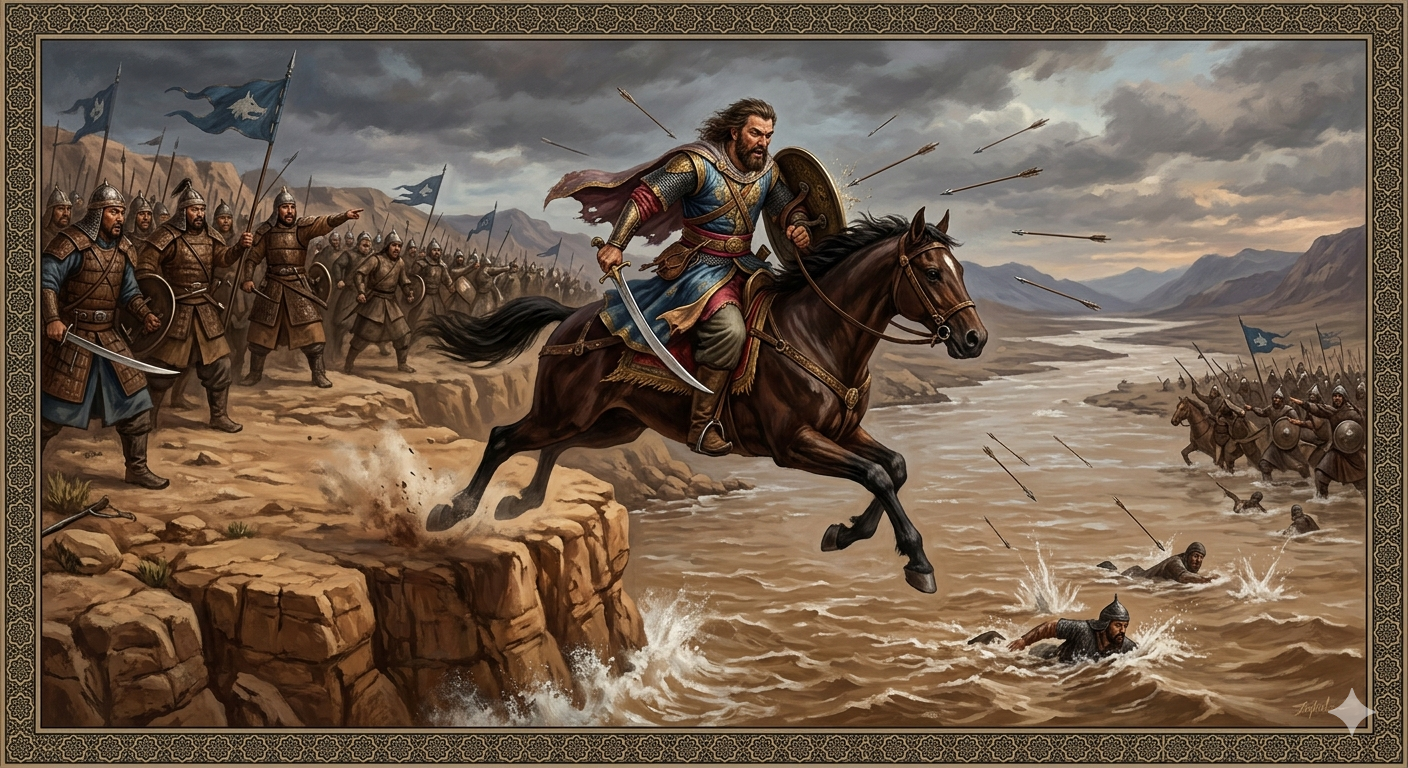
What followed was one of the most heroic and desperate battles in medieval history. Jalal al-Din did not cower. He launched wave after wave of furious cavalry charges into the heart of the Mongol army, fighting like a wounded lion. His men fought to the last breath, but they were hopelessly outnumbered. As the Mongol circle tightened, tragedy struck. To prevent his mother, wives, and daughters from falling into the hands of the Mongols, he tragically ordered them to be drowned in the river—a heart-wrenching decision that haunted him forever.
The Immortal Leap
With his army destroyed and the Mongols closing in on him from all sides, Jalal al-Din made a decision that echoed through eternity. He mounted his finest warhorse, stripped off his heavy armor, took his shield and sword, and charged directly toward the edge of a 30-foot cliff. With a massive battle cry, he spurred his horse and leapt off the cliff into the roaring, turbulent waters of the Indus River.
Genghis Khan rode to the edge of the cliff, stopping his archers from shooting. He watched in sheer awe as the lone Sultan, shielding himself from stray arrows, successfully swam across the violent river and climbed onto the opposite bank in India. Deeply moved by this superhuman display of bravery, Genghis Khan pointed to Jalal al-Din and said to his sons: “Such is the son a father should have! If he survives, he will be a terror to us all.”
Episode 4: The Indian Exile and the Endless Wars
Refugee in a Strange Land
Jalal al-Din arrived in the Indian subcontinent with nothing but his sword and a few dozen survivors who had managed to swim across. He reached out to Sultan Iltutmish, the ruler of the Delhi Sultanate, requesting asylum. Iltutmish, however, was a wise and cautious ruler. He admired Jalal al-Din’s bravery but knew that harboring him would bring the wrath of Genghis Khan down upon Delhi. He politely refused, sending gifts but forcing Jalal al-Din to survive on his own.
Conquests in Sindh and Punjab
Refusing to fade into obscurity, the Khwarazmshah began forging a new kingdom in exile. Between 1221 and 1224, he campaigned in the Salt Range (modern-day Pakistan), defeating the local Khokhar tribes and marrying the daughter of their chief to secure an alliance. He then marched south into Sindh, fiercely battling the local ruler Nasir al-Din Qabacha. He captured cities, gathered wealth, and built a new army. Yet, despite establishing a strong domain in India, he never forgot his true goal: reclaiming his homeland and avenging his family.
The Return to the West
In 1224, hearing that his brother had established a fragile kingdom in Persia and that the Mongol main force had withdrawn to Mongolia, Jalal al-Din marched his army out of India. He traveled through Makran and Iran, quickly asserting his dominance. He captured cities like Tabriz and Maragha, and in a brutal campaign, he conquered the Christian kingdom of Georgia, sacking its capital, Tbilisi, in 1226.
For a brief moment, it seemed the Khwarezmian Empire was reborn. However, Jalal al-Din made critical political mistakes. Instead of uniting the Islamic world against the inevitable return of the Mongols, he aggressively attacked his Muslim neighbors—the Seljuks of Rum, the Ayyubids in Syria, and even threatened the Abbasid Caliph in Baghdad.
Episode 5: The Tragic End of a Warrior King
The Battle of Yassıçemen (1230)
Jalal al-Din’s endless aggression forced his Muslim neighbors to unite against him. In 1230, a massive coalition army of the Seljuks (led by Alaeddin Keykubad) and the Ayyubids clashed with Jalal al-Din at the Battle of Yassıçemen. The Sultan, exhausted from years of continuous warfare, suffered a crushing defeat. His army was scattered, and his power was broken.
The Final Hunt
The timing could not have been worse. Just as his power faded, the Mongol Empire, now ruled by Genghis Khan’s successor Ogedei Khan, sent a massive new army led by the terrifying general Chormaqan. Their only mission: find and kill Jalal al-Din.
The pursuit was relentless. Jalal al-Din fled from city to city, betrayed by his former allies, and constantly harassed by Mongol vanguards. In August 1231, exhausted, sick, and accompanied by only a few loyal guards, he sought shelter in the rugged mountains of Kurdistan.
A Quiet Death for a Loud Life
The man who had survived the wrath of Genghis Khan, the horrors of the Indus River, and a decade of endless war did not die on a glorious battlefield. While resting in a Kurdish village, he was recognized. A local Kurdish mountaineer, allegedly seeking revenge for a family member killed by Khwarezmian troops years earlier, sneaked into the Sultan’s tent while he slept and murdered him with a spear.
The Legacy of the Last Khwarazmshah
Thus ended the life of Sultan Jalal al-Din Mangburni. Though he failed to save his empire, he is remembered not as a failure, but as the ultimate symbol of resistance. In an era when kings surrendered and empires crumbled before the Mongols, Jalal al-Din stood up and fought. His courage at the Indus River remains etched in history—a brilliant, tragic warrior who refused to bow to fate.